The Recognition
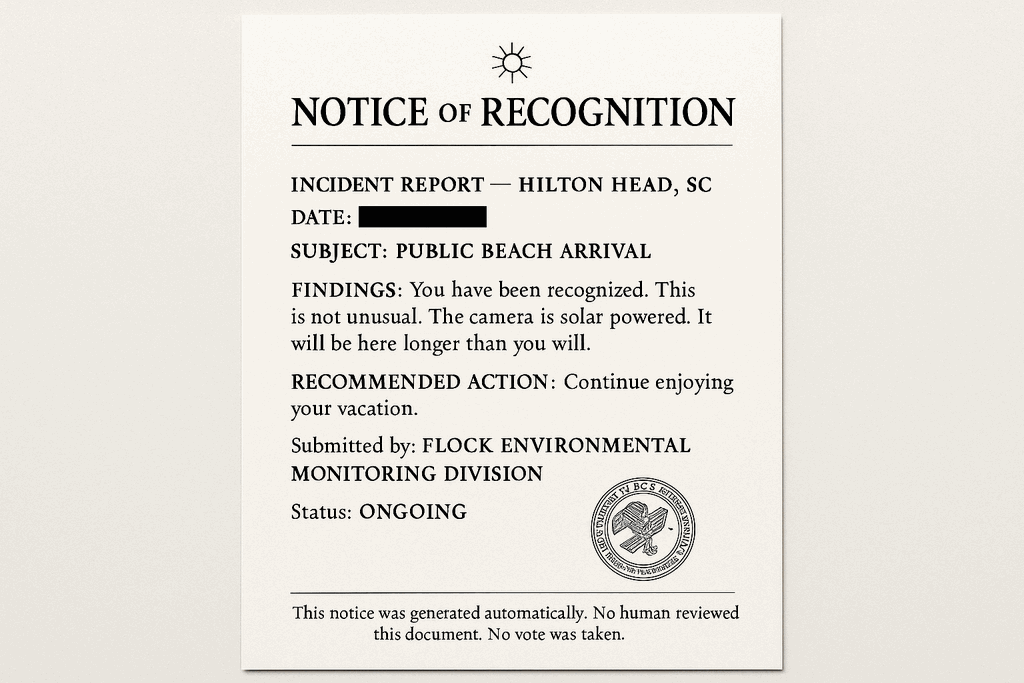
Solar-powered cameras appeared on the beach in Hilton Head, South Carolina. There was no vote. There was no announcement. One day they were there, the way a good decision always arrives: completely without you.
The cameras are made by a company called Flock. (This is their actual name.) They have biometric identification capabilities, meaning they can recognize a face. The beach has faces. The math is simple.
I want to walk you through what happens next, because I have studied the documentation, and the documentation is very clear about the process. When a Flock camera recognizes your face, it compares it against a database. The database is not explained. The comparison produces a result. The result is acted upon. By whom is also not explained. The explanation is ongoing.
You, as a person at a beach in South Carolina, are probably asking: "Was I supposed to know about this?" The city of Hilton Head is aware that you have this question. They would like to address it after the next council meeting, which is scheduled for the third Thursday of next month, assuming a quorum.
The cameras run on solar power. This is significant. The sun also visits the beach. Unlike you, it does not need a parking space. Unlike you, it is there every day. Unlike you, it is powering the cameras that are watching you, meaning that your vacation is, in a mechanical sense, the energy source for your own surveillance.
The correct response to learning this is unclear. The cameras do not have an email address. Flock's contact page does exist (I checked), but it is designed for law enforcement agencies looking to purchase cameras, not for beachgoers looking to opt out of having their faces stored. The opt-out process is not on that page. I looked for the opt-out process. There is no opt-out page. There is a page about features. The features include biometric identification. The features do not include opting out.
You could stay home. But the cameras were installed in a public space. The public space is near your home. The cameras are solar-powered. They are not going anywhere. You might be.
The cameras have been described as a tool for public safety. This is accurate. Safety is the thing they are for. Your face is the thing they are doing it with. These two sentences are both true and can coexist, which is the entire premise of modern governance.
I find the solar power the most interesting part. Whoever decided to put biometric cameras on a public beach without a vote thought about energy costs. They factored in the electricity bill. They found a solution. The solution was the sun. They did not think about the vote because they were busy thinking about the electricity bill, and you can only optimize for one thing at a time, and they chose the sun.
The cameras are still there. So is the sun. So, technically, are you, at least for the week you booked.